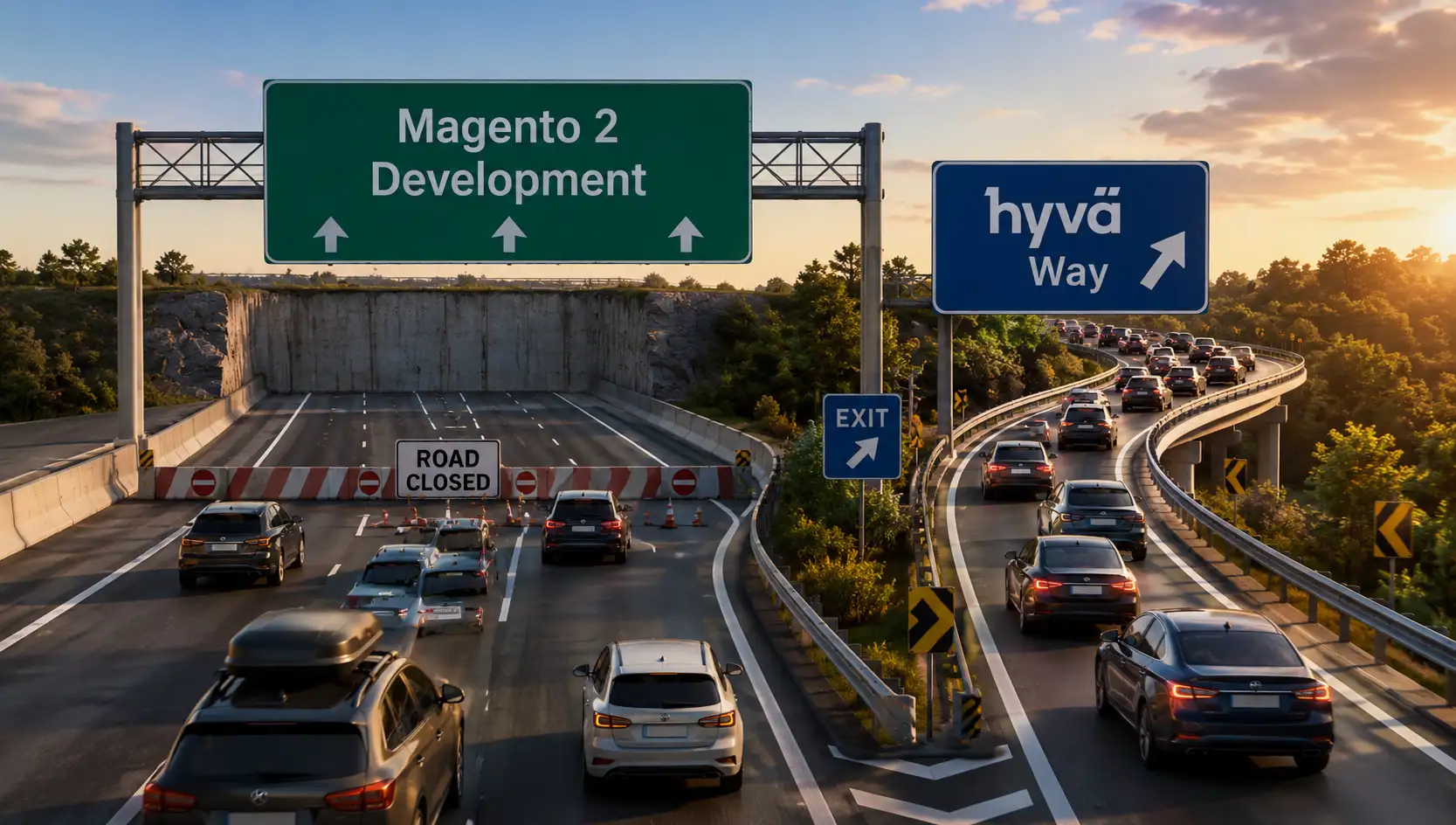
Hyvä went from a paid license to free. That removed the one remaining barrier that was slowing down adoption – the justification conversation. Now there is no strong argument for starting a new Magento 2 project without it. And that is quietly changing what “standard” looks like across the Magento ecosystem.
But there is a version of this story that gets oversold. So here is the honest breakdown – what Hyvä actually changes, what it does not, and what the shift to free really means for shops and agencies working with Magento 2 today.
To understand what Hyvä solves, it helps to understand what it replaced.
The default Magento 2 frontend – built on RequireJS, KnockoutJS, and UIComponents – was designed around 2015. It made sense at the time: a component-based JavaScript system that could handle complex storefront interactions without requiring a full page reload.
The problem is that this stack aged poorly. RequireJS became a source of complex dependency chains that were difficult to debug and slow to load. KnockoutJS fell out of mainstream use while the rest of the frontend world moved to React, Vue, and then lighter reactive frameworks. UIComponents – Magento’s abstraction layer on top of all of this – added another layer of complexity that few developers found intuitive.
The result was a frontend that:
Experienced Magento developers could work around these limitations. But it required effort, and that effort had a cost – in development time, in ongoing maintenance, and in the performance ceiling that was difficult to push past without significant custom work.
Hyvä replaces the entire Magento 2 frontend rendering stack. In place of RequireJS and KnockoutJS, it uses Alpine.js – a lightweight reactive JavaScript framework with a minimal footprint. In place of Less and Magento’s CSS inheritance system, it uses Tailwind CSS – a utility-first framework that is now one of the most widely used styling approaches across the industry.
The practical result of this swap is significant:
Performance. Pages built on Hyvä ship dramatically less JavaScript than their Luma equivalents. This translates directly into better Core Web Vitals scores – particularly LCP (Largest Contentful Paint) and FID (First Input Delay). Stores that were struggling to pass Google’s performance thresholds on Luma often hit acceptable scores on Hyvä without additional optimization work.
Development speed. Tailwind is widely known. Alpine.js is simple enough to learn in a day. This means that frontend developers with no previous Magento experience can contribute meaningfully to a Hyvä project far faster than they could on Luma. For teams and agencies, this reduces onboarding friction and makes staffing more flexible.
Maintainability. Less code on the frontend means fewer moving parts, fewer things that can break across Magento upgrades, and cleaner codebases that are easier to hand off between developers. The Luma inheritance system – where theme changes cascaded through multiple layers of files – is replaced by a more direct approach that is easier to reason about.
Developer experience. Working on a Hyvä project looks and feels like working on a modern web project. This matters for team morale, for attracting developers, and for the long-term quality of the codebase.
This is the part that sometimes gets oversold, and it is worth being direct about.
Hyvä is a frontend theme. It changes how the store looks and behaves in the browser. It does not change anything about how Magento 2 works on the backend.
The catalog, pricing rules, customer segmentation, promotions, order management, shipping logic, payment integrations, multi-store configuration, ERP integrations – all of this is Magento backend territory, and Hyvä does not touch any of it. If your store has complex business logic or deep third-party integrations, that complexity remains exactly as it was. You still need experienced Magento 2 backend developers to work with it properly.
Extension compatibility is a real consideration that should not be glossed over. The Magento extension ecosystem is large, and many extensions include frontend components – custom product pages, checkout steps, review widgets, loyalty programs, and so on. Not every extension has a Hyvä-compatible version of these components. Before committing to Hyvä on a project with a significant extension stack, it is worth auditing which extensions are affected and whether Hyvä-compatible alternatives exist.
The ecosystem has grown substantially and most common extensions now have Hyvä support, but gaps still exist – particularly with older or more niche extensions. This is a solvable problem in most cases, but it adds scope that needs to be accounted for.
The checkout deserves a specific mention. The default Magento 2 checkout is also built on KnockoutJS, which means it is outside of what the base Hyvä theme covers. The Hyvä ecosystem includes a separate Hyvä Checkout product for this, and there are other alternatives in the market. But it is a separate decision and a separate scope item – not something that comes automatically with the theme.
When Hyvä had a license fee, every project needed to justify the cost. That meant a conversation about ROI, a line item in the budget, and sometimes a decision to go with Luma because the numbers did not work out for that particular project.
That conversation is now gone.
The question has flipped. It used to be “why should we pay for Hyvä?” Now it is “why wouldn’t we use it?” And that is a very different conversation to have – because the answer has to be a specific technical or business reason, not just cost.
The effect is visible across the ecosystem. Agencies that were selectively using Hyvä on larger projects are standardizing on it across all new builds. New projects are starting with it as the expected foundation rather than as an upgrade option. Merchants evaluating Magento 2 are increasingly arriving with Hyvä already on their list – they have heard of it, read about it, and expect it to be part of a modern implementation.
This is what a shift to “gold standard” looks like. Not an announcement or a mandate – just a gradual change in default assumptions until the question becomes “why not?” instead of “why?”
Starting a new Magento 2 project: Hyvä is the right starting point. Audit your extension stack early to identify any compatibility gaps, plan the checkout separately, and factor in the Hyvä-specific frontend development work. The additional effort at the start pays back quickly in performance and ongoing maintainability.
Running a live Magento 2 store on Luma: There is no emergency. An existing Luma store that is working well does not need to be migrated immediately. But if you are planning a significant redesign, a replatform conversation, or a major frontend rebuild, Hyvä should be the direction. Migrating from Luma to Hyvä mid-lifecycle is a real project – it is not a theme swap. Plan it as part of a larger initiative rather than treating it as a quick change.
Migrating from Magento 1: When building the new M2 store, Hyvä is the natural choice for the frontend layer. Factor it into the project scope from the start rather than defaulting to Luma with the intention of switching later. Doing it later always costs more.
Running an agency or building on Magento for clients: Standardizing on Hyvä makes sense now that cost is no longer a variable. It simplifies team skills, makes knowledge transferable across projects, and produces better outcomes for clients by default. The investment in building Hyvä expertise within your team has a clear long-term return.
Hyvä changes the frontend. The rest of Magento stays the same.
It is not a platform change, and it does not reduce backend complexity. But for page speed, developer experience, and the long-term maintainability of your frontend layer, it is the right foundation. The performance improvements are real, the developer experience improvements are real, and the ecosystem has matured to the point where most standard use cases are covered.
And now that cost is no longer a factor, there is not much of an argument left for the alternative.
If you are planning a new Magento 2 project, evaluating a frontend rebuild, or trying to understand what a move to Hyvä would actually involve for your specific setup – we are happy to walk through it practically. No pitch, just an honest look at what makes sense.